| >> Choose Zhejiang | >> Choose Zhejiang Business Card |
| Hangzhou | Ningbo | Wenzhou | Jiaxing |
| Huzhou | Shaoxing | Jinhua | Quzhou |
| Zhoushan | Taizhou | Lishui |
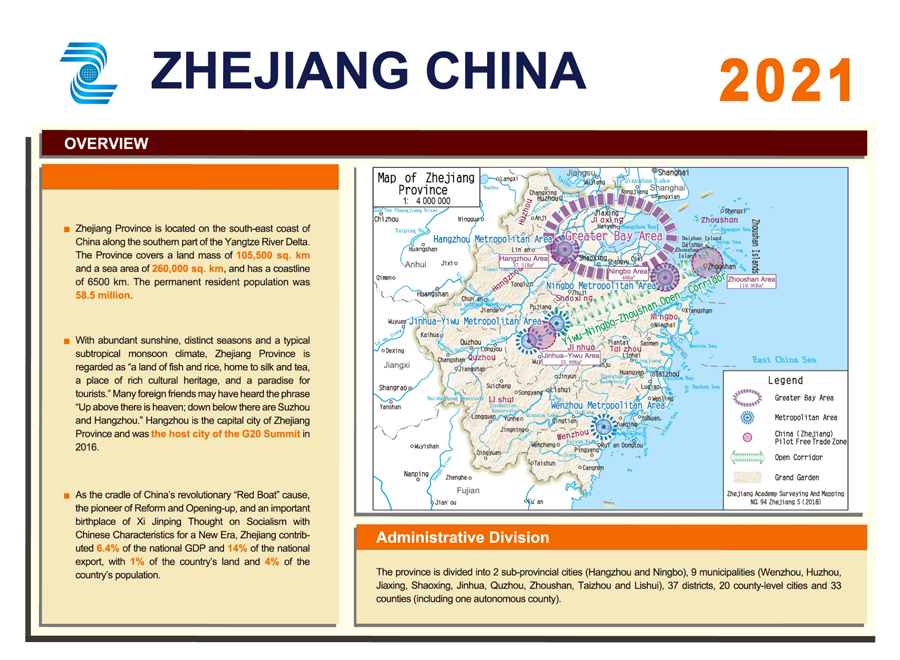
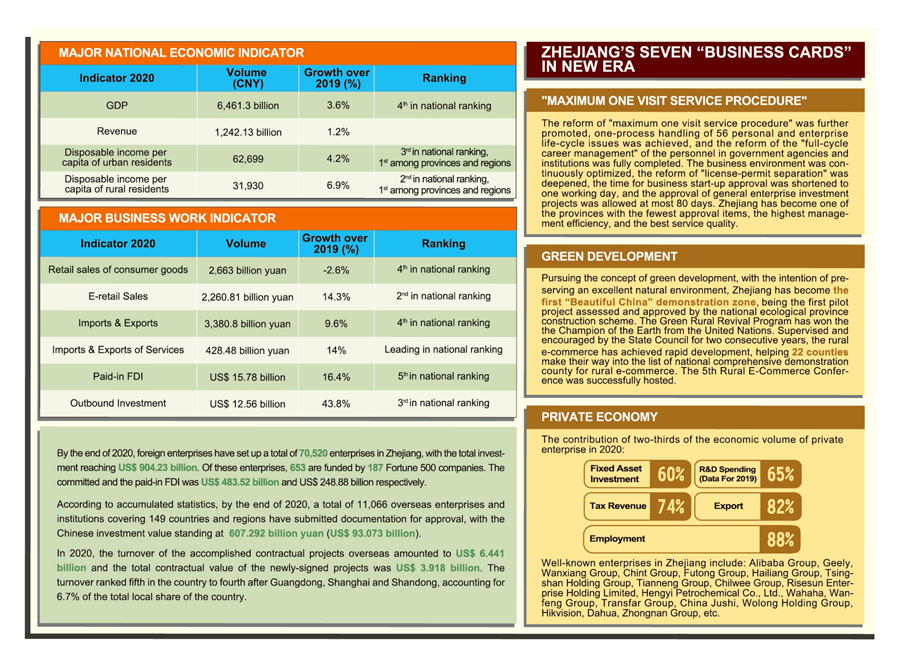
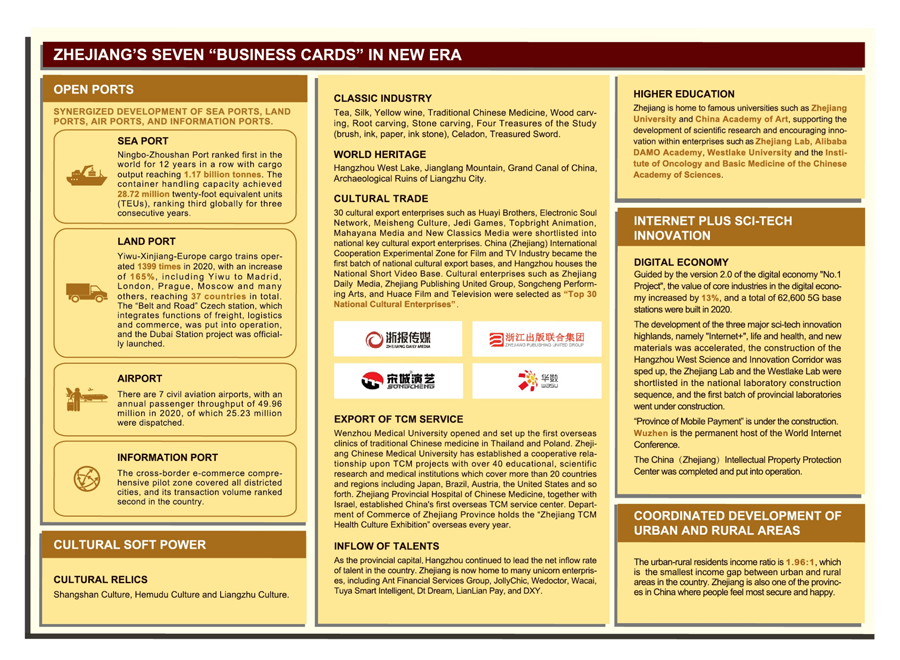
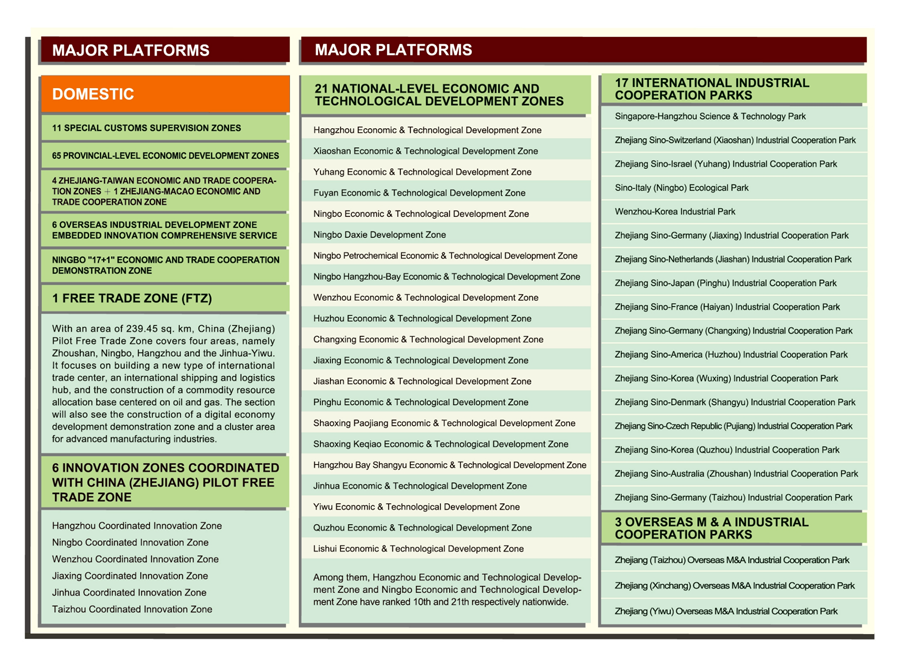
Located in western Zhejiang province, Quzhou is a center city on the borders of four provinces, namely, Zhejiang, Fujian, Jiangxi and Anhui. It is consisted of 6 counties (county-level cities, districts), and covers an area of 8,841 km2 . The total population is 2.54 million.
I. Location and Travel Advantages. Having staggered transport ways by water, land and air, the transportation system of Quzhou leads to all directions. Four highways, namely, Hangzhou-Xin’an Jiang-Jingde Town, Hangzhou-Jinhua-Quzhou, Longyou-Lishui-Wenzhou and Huangshan-Quzhou-Nanping (Beijing-Taiwan Highway), and national ways 205 and 320 pass the city; the electrified railway Shanghai-Kunming line runs through the city; Hangzhou-Changsha high-speed railway takes local people 1 hour to Hangzhou and 2 hours to Shanghai; airlines to Beijing, Shenzhen and Xiamen are available at Quzhou airport; Qujiang level-4 passage on the upstream Qiangtang River leads to Hangzhou , and it has a capacity of 500 tons.
II. Resource Advantages. With a total amount of 10 billion cubic meters, Quzhou is rich in water resources, and the per capita possession of surface water resource is 2,640 cubic meters, which is more than twice the level of provincial average. Quzhou is the only city in Zhejiang province whose quality of drinking water meets the standard of national surface water level grade 1. Quzhou is rich natural resources, there are proven reserves of more than 50 kinds of minerals, and with a reserve of 11.3 billion tons, limestone is the key mineral resource, meanwhile, stone coal, granite, marble, bauxite ore, fluorine, etc. are also rich, the reserve of them ranks first in the province.
III. Industry Advantages. Quzhou is the only industry base in domestic which has the development foundation of the two high-end industries of fluorine and silicon in simultaneous, and it was awarded by the National Ministry of Science and Technology as the new material industry base of fluorine and silicon in the national torch plan. Quzhou is also the national pneumatic machinery industry base, high-grade specialty paper industry base of China, national green leisure food and health drink industry base, pv industry base of Zhejiang province, and electronic components and materials industry base of Zhejiang province.
Hangzhou is the capital of Zhejiang Province, the national historical and cultural city and international tourism city, which has location advantages, abundant human resources,mature market mechanism, efficiency government service and solid industry foundation. . Hangzhou is known as a paradise of living, paradise of tourism and leisure,and paradise of investment and entrepreneurship.
Hangzhou’s comprehensive strength ranks 4th among all provincial cities, 5th among sub-provincial cities and 10th among national large and medium-sized cities. In 2014, the city's GDP reached 920 billion Yuan, and fiscal revenue reached more than 190 billion Yuan. The per capita GDP reached more than $16000, close to the developed country level. Hangzhou is abundant with private wealth. In 2014, 50 private enterprises of Hangzhou were selected into the China Top 500 Private Enterprises list, the number of which ranked 1st among all the cities in China for 12 consecutive years.
At present, Hangzhou is promoting the economic transformation and upgrading to speed up the construction of pilot city of Beautiful China and modern international metropolis. The "number one project" focusing on the special advantages to implement with information economy development and promote intelligence applications provides a good opportunity for entrepreneurial innovation.
In March 2014, Hangzhou has successfully built the Cross-border E-commerce Comprehensive Experimental Area. At the same time, Hangzhou is now actively constructing national independent innovation demonstration area, which is to play a leading and exploratory role in independent innovation and high technology industries development The two Areas will become the great powerful engine for Hangzhou’s economic efficiency and the transformation of development.
Hangzhou is the host city for G20 summit in 2016 and 2018 world short course swimming championships and world swimming Event. In the next five years, Hangzhou will also hold a series of international summits and international sports events such as G20 Summit in 2016, which will bring more and more investment and business opportunities.
Huzhou is a renowned ancient city in the south of Yangtze River with a long history of more than 2,300 years and it is the only city named after the lake around Taihu Lake. Now there are Deqing, Changxing and Anji three counties, Wuxing and Nanxun two districts under jurisdiction of Huzhou municipality, covering a total area of 5,818 square km with a population of 2.62 million.
Convenient Transportation and Superior Location Advantage
Huzhou is located in the heart of Yangtze River Delta and it is the common hinterland shared by Shanghai, Hangzhou and Nanjing three big cities. Huzhou, as an important urban node, links the both wings of the south and north in Yangtze River Delta and bridges the eastern part with the midland of China, and it is only 75 km from Hangzhou, 130 km from Shanghai and 220 km from Nanjing. Huhzou is served by state-of-the-art transportation networks - four major expressways, two trunk highways, Xuan-Hang Railway, Hangzhou-Nanjing high-speed railway, and Chang-Hu-Shen waterway reputed as the little oriental Rhine, enjoying easy access.
Abundant Cultural Heritages and Traditions
Huzhou has the reputations of the home of silk, the land of abundance and the state of culture. There was a saying in as early as Song Dynasty that when Huzhou and Suzhou had a bumper crop, the whole country is free from hunger. Huzhou is the birthplace of writing brush culture, silk culture and tea culture. Huzhou always advocates literacy and education. There is a galaxy of famous talents in the history of Huzhou. Cao Buxing, Meng Jiao, Zhao Mengfu, ShenJiaben, Wu Changshuo, ShenYinmo and many celebrities in the history were all born in Huzhou Many other famous people, such as Wang Xizhi,Yan Zhenqing and Su Shi etc. were used to live in Huzhou. In the art history, many masters of calligraphy and painting were the natives of Huzhou. It’s no exaggerating to say that Huzhou makes half of the Chinese calligraphy and painting history.
Picturesque Landscape and Beautiful Ecological Environment
The tourism of Huzhou features six well-known brands, Taihu Lake, ancient towns, famous mountains, vast bamboo forests and wetlands, and palaeoecological diversity. The new landmark of Huzhou City – Moon Hotel sits in the beautiful Taihu Lake Resort. The Nanxun ancient town is honorably titled as the top ten Chinese glamorous town. Deqing is home to famous Mogan mountain – one of the four summer resorts of China, and Xiazhu lake - the largest wetland in the south of Yangtze River. Changxing is known for ten-mile corridor of ancient gingko trees, Yangtze alligators, golden spike ancient ecological wonders. Anji is the bamboo town and the first eco-county of China.
Harmonious Society and Booming Economy
In recent years, the economy and society of Huzhou City has experienced a rapid, sustainable and coordinative development. In 2014, the regional GDP for Huzhou stood at RMB 195.6 billion, an increase of 8.4% compared to previous year, the total fiscal income RMB 29.57 billion, an increase of 8.8%, of which the total financial income for the local government was RMB 16.78 billion, an increase of 8.5%. The per capita disposable income for urban residents achieved RMB 38,959 and the per capita net income for rural residents RMB 22,404. The society of Huzhou City is peaceful and orderly and the public satisfaction ranks the front in Zhejiang Province. Sticking to its industrial dominance and relying on innovation, committing to improve people’s livelihood and ecological environment, the focus of future development of Huzhou can be summed up by four key words – strength, vitality, charm and happiness. We are making efforts to speed up the construction of a modern lakeside ecological city, and strive to realize basic modernizations in Huzhou ahead of time.
Jiaxing covers a land area of 3,915km2, home to a residential population of 4.56 million, and having five counties (cities) and two districts under its administrative jurisdiction. In 2014, it achieved a gross regional product of RMB 335.28 billion Yuan, with GDP per capita reaching USD 11,959.
Located in the geographic center of Yangtze River Delta, Jiaxing is a road transport hub in the delta, 90 km away from Shanghai and Hangzhou and 70 km away from Suzhou resepectively. It takes only 25 minutes to reach Shanghai and Hangzhou by high-speed rail, not to mention the other six expressways that achieve fast connection of Jiaxing’s economy to the Yangtze River Delta Economic Circle. Moreover, there are five international airports and three major seaports within its 1-1.5 hour driving radius.
Jiaxing has been awarded numerous honors and titles including the “National Civilized City”, “China's Famous Historical and Cultural City”, “Outstanding Tourist City of China”, “National Garden City”, “Green City Exemplar of China”, “National Healthy City” and “Outstanding City of China in Social Security Comprehensive Management”.
In 2014, the gross industrial value of enterprises above designated size was RMB 736.5 billion Yuan, of which the added values contributed by enterprises above designated size in the emerging industries, high-tech industry, and equipment manufacturing increased by 12.8%, 11.7% and 15.7% respectively and accounted for 39.6%, 38.2% and 24.3% of the industrial added value above designated size.
Jiaxing has well-developed foreign trade. In 2014, it achieved a total import and export of USD 33.734 billion, of which the export value accounted for USD 23.651 billion.
Jiaxing is attraction for foreign investors. By the end of 2014, Jiaxing has cumulatively granted approvals to 6,900 foreign-invested businesses, utilized foreign capitals of USD 19.63 billion in reality, and attracted the landing of 51 projects from the world’s top 500 companies, including Philips, Shell, Lego, Heineken, Abbott, and Mars.
Pillar Industries: auto parts, optical and electrical machinery, photovoltaic, solar heat, electronic information, textile and clothing, leather and luggage, and new chemical materials.
Encouraged Industries: equipment manufacturing, new materials, new energies, bio-pharmaceutics, energy-saving and environment protection, the internet of things, new-generation electronic information, auto parts, service outsourcing, headquarters economy, ocean economy, sci-tech R&D, and modern logistics.
Ningbo is located at the middle piece of Chinese continental coastline, the south wing of well-developed Yangtze River Delta. Being one of the first batch of open coastal cities, cities with independent planning and sub-provincial cities, Ningbo has witnessed the sustained and fast growth of the economy. In 2014, it achieved a GDP of 112.4 billion U.S. dollars with GDP per capita being 16112 U.S. dollars and a general financial revenue of 13.9 billion U.S. dollars.
Being major transport center in Yangtze River Delta Economic Zone, Ningbo is the only city with three cross-sea bridges in mainland China. In 2014, Ningbo port ranked the third in China and the fifth in the world in terms of cargo handling capacity. The volume 530 million tons of goods and the number 18.7 million of standard containers clearly shows its handling capability. Ningbo international airport is one of four international airports at Yangtze River Delta economic zone. Its two railways and a number of express ways connect various regions of the country. The first phase of urban mass transit line 1 in city area has already tried pilot run, and eventually 7 urban mass transit lines will be built. With the launch of both cross-sea bridge connecting Ningbo and Shanghai and high-speed rail, the city Ningbo has been incorporated into Shanghai 1~2-hour intercity transportation circle.
Since the reform and opening up, Ningbo’s industry has undergone rapid development: its port-surrounding large-scale industries covering petrochemical industry, steel, electric power, automobile, and ship repair and building etc. is well developed; traditional industries with advantages in fields of textile and garment, machinery, household appliances and stationery has a good foundation; the newly-developing high and new technology industries showing rapid growth on electronic information, new material, new energy, new equipment, energy conservation and environment protection as well as biological medicine. In 2014, Ningbo’s total industrial output value reached RMB 1.7 trillion and approximate 80% of the city’s GDP was produced by its private economy comprised with more than a hundred thousand privately-owned enterprises.
Ningbo is the most competitive hot spot region for foreign investment in Shanghai economic region. It has attracted more than 15000 foreign-invested enterprises from over 100 countries and regions to invest here, with total investment breaking through 120 billion U.S. dollars. At present, more than 50 Fortune Top 500 enterprises have set up their branches or have invested in Ningbo. The city has set up 10 national level development zones and 9 key development zones. In recent years, the city has successively established some international cooperative parks such as China (Ningbo)-Italy Ecological Park and Singapore Mapletree Modern Industrial Innovation Park. It also established multi platforms for emerging industries like Meishan Marine Ecology Science-Technology Town and Ningbo New Material Science Town.
At present, Ningbo is firmly carrying forward the building of “Port Economic Circle” by taking advantage of the strategy “Belt and Road” and great opportunity of developing Yangtze River Economic Zone. Businessmen at home and abroad are welcomed to invest in Ningbo.
SHAOXING, CHINA
A CITY OF LEGEND
◎ A City of Cultural and Historic Heritages
◎ UN-habitat Award
◎ China Clean City
◎ China Garden City
◎ Best Tourist City of China
◎ An Environment-friendly City
◎ CCTV Most Fascinating City of China
◎ 2008 Top Ten Happiest Cities in China
◎ Forbes Top Commercial Cities in China
Shaoxing, located in North-Central Zhejiang, is 200 km from Shanghai, with Hangzhou in the west, Ningbo in the east, and the Hangzhou Bay in the north. Shaoxing covers 8,256 km2 with a population of 4.41 million. Shaoxing is a historic and cultural city, a National Civilized City, an ecological and livable water city in South China, and a central city in the Yangtze River Delta region. Now, its GDP per capita reaches up to 13,000 US dollars.
Shaoxing—an Open Coastal City
Shaoxing has established long-term friendly relationship with over 30 cities worldwide. Foreign investors from over 90 countries and regions have invested in Shaoxing, including the Global Fortune 500 such as Siemens, Philips, SK, Panasonic, Toyota, Itochu, Sojitz, etc. Shaoxing’s annual total volume of import and export trade exceeds 35 billion US dollars.
Shaoxing--the most dynamic city of China for private sector
Shaoxing is a city full of comparative advantages. Private economy accounts for over 95% and 24 enterprises have ranked among the Top 500 Chinese Private Enterprises. In Shaoxing, there are over 50 listed companies and 377 national high-tech enterprises.
Shaoxing—A Golden City in Investment Environment
Shaoxing is only 25 km from Hangzhou Xiaoshan International Airport. As Jiaxing-Shaoxing River-Crossing Bridge has been open to traffic, it takes only 1.5 hour drive to Shanghai from Shaoxing. Railways and expressways intersect in Shaoxing.
Shaoxing has 12 key economic development zones (industrial parks) , with a total planning area of over 1,000 km2.
Colleges and universities in Shaoxing provide tens of thousands of graduates for the society every year.
Shaoxing has excellent public facilities, with its power supply can be sufficiently guaranteed, its urban drinking water quality has been up to the European Community Drinking Water Standard; and its daily sewage treatment capacity has reached 1.47 million tons.
Shaoxing can also provides package service for foreign investors and one-stop green channel for the approval of foreign investment projects.
Shaoxing’s industrial economy has distinguished features. Shaoxing is not only the birthplace of Chinese Yellow Wine but also its production and export base. And, textile fabrics, neckties, energy-saving lamps, automobiles, environmental protection equipment, dyes, etc. account for a major proportion in the production volume in China and even in the world.
Shaoxing now has five competitive industries, namely, textile and chemical fiber, machinery and electron, pharmaceuticals and chemicals, energy conversation and environmental protection, and food and beverage, and is accelerating development of emerging industries such as advanced equipment manufacturing, new materials, bio-medicine, energy conversation and environmental protection, new energy, emerging information industry, marine economy, general aviation and life health.
Du Fu, a Tang Dynasty poet, once described Taizhou in his famous poem: “Sprawling sea with lush islands and beautiful clouds meeting on the horizon.”
Located along the south-east coast of Zhejiang province, in the south of Yangtze River Delta Economic Zone, Taizhou covers 9,411 square kilometers and enjoys a continental coastline of 745 kilometers. It has 3 districts, 2 county-level cities and 4 counties, with a permanent population of 6 million.
Taizhou is the birthplace of China’s shareholding co-operative system and also one of the most active area of private businesses. Under the market economy, various famous enterprises such as Geely, Supor, Hisun, Xingxing have sprung up and witnessed the miracle of China’s manufacturing industry. Besides, Taizhou has obtained various titles, such as Outstanding Innovative City, Best Commercial City, National E-commerce Demonstration City, National Automobile and Auto Parts Export Base, National Science and Technology Innovation Base in the Revitalization of Trade (Biomedical), and National Demonstration Center of Trade Upgrading (Motorcycle & Parts and Outdoor Leisure Products). All of these titles compose the gorgeous melody of Taizhou’s all-round developments in economy and society.
In 2014, the city’s GDP, and total and local fiscal revenue reached ¥338.751 billion, ¥48.529 billion, and ¥26.521 billion respectively. The totals of investment in fixed assets, retail sales of consumer goods and foreign trade value were ¥176.587 billion, ¥164.632 billion, and $22.08 billion respectively. As to the livelihood of people, the urban per capita disposable income was 39,763 yuan and the rural per capita net income was 19, 362 yuan.
The municipal government of Taizhou is working with all its efforts to build itself a modern harbor metropolis, which combines the roles of international intelligently-manufacturing city, harbor city of Maritime Silk Road, and livable city with mountains and sea. It is endeavoring to expand its openness, cooperation and exchanges and is actively integrating itself to the layouts of "One Belt and One Road" and Yangtze River Economic Belt. With an open and positive mind, Taizhou welcomes every investor from home and abroad to create a new future in Taizhou.
City of Fashion, City of Scenery
Wenzhou is the “frontier” putting the reform and opening up policy into practice, as well as the pioneer for Zhejiang Province to extend exchange and cooperation with foreign countries. Under the new situation, putting emphasis on foreign exchange and cooperation, the Government of Wenzhou City implements the “five-zation strategy” as ecologicalization, informatization, fashion-orientation, urbanization and internalization to change Wenzhou into an ecological and intelligent fashion city in the world characterized by ecological civilization, national e-commerce demonstration and Chinese wisdom.
Wenzhou is located in the middle of the golden coastline of Southeast China, with mountains, rivers, streams, lakes, island and plain. The city, supports a good environment combining life, production and ecologicalization with beautiful scenery and abundant natural resources. With a land area of 11,800 square kilometers and a sea area of 11,000 square kilometers, it governs three districts, two cities and six counties with the a resident population of 9,070,000 among a total population of over 30,000,000. And there are three national scenic spots, two national nature reserves and five national forest parks.
Since the reform and opening up, Wenzhou, famous for developing fully and boldly, opening entrance and expanding opening up, has become the first one to develop individual private economy and joint-stock cooperation economy, to reform financial system and system of small towns, and to make use of the market mechanism in the construction of city, meanwhile, Wenzhou has built the “Wenzhou business” network all over the world, creating many “firsts in China”, through the innovative economic philosophy “small goods in big market”. In recent years, Wenzhou had never stopped innovating and stepped pace of orientational significance in enterprise system innovation, financial system reform and government functions transformation. Consistent innovation and everlasting vitality give Wenzhou reasons to maintain good momentum of development in economy.
(I) Active private economy, developed Wenzhou business network. Wenzhou, as the birthplace of China’s private economy, has nourished vital “Wenzhou merchants” renowned at home and abroad who develop the private economy fundamentally and is the unique advantage and valuable resource for Wenzhou’s economical development. At present, the number of private enterprises in Wenzhou accounts for 99.5%, the value of industrial output 95.5%, tax payment 80%, foreign trend exports 95% and employees 93%. Pushed by the reform and opening up and market economy, Wenzhou merchants is a group or enterprisers understanding the market operation rules and operation management, complying with the laws and international regulations and taking social responsibility; at the same time, flexible market mechanism and vital Wenzhou business network has done much for the foreign products to enter into Chinese market and to exploit the international market, which explains the fact that over 600,000 Wenzhou Chinese at abroad has established more than 260 industrial and commercial organization in 131 countries and regions around the world and about 1.800,000 people doing business all over China has founded Wenzhou Chamber of Commerce in 252 cities at prefecture level and above. These Wenzhouers have sold Wenzhou commodity to more than 200 countries and regions reaching an annual trade volume of 110,000,000,000 dollars in over 2,000 various markets established by them.
(Ⅱ) Advantageous location, vast development space. Wenzhou has been listed among 45 communication hub in China with international airports, with high-speed rails and bullet trains connecting all over China and expressways running through the four-hour expressway network in Zhejiang Province to form a convenient traffic network as the international metropolis. Wenzhou Longwan International Airport is a first class domestic airport with passenger throughout ranked second in cities at prefecture level and above and has established non-stop flights with 71 large and medium-sized cities as well as Taiwan, Hong Kong, Macao, the South Korea, Thailand, the Philippine, Italy, Vietnam and Canbodia. Port of Wenzhou, as an important national hub port among 25 main ports along the coast around China, has established shipping and trading relationship with the ports in more than 50 countries and regions all over the world with 16 large tonnage berths and 28 over-one-hundred-thousand-ton berths under planning and construction. With a lot of exploitable beach area, Wenzhou possesses abundant development space in coastal region. Nowadays a total reclamation area of 266 square kilometers has been approved, of which an area of 80 square kilometers for construction land, which is suitable for centralized exploitation and construction in large scale. Wenzhou Economic and Technological Development Zone and Oujiangkou District of Wenzhou City, neighboring Wenzhou Longwan International Airport and the three core port districts as Wenzhou Zhuangyuanao International Port District, Big-Small-Door-Island Port District and Leqing Port District, have abundant development space due to Ningbo -Taizhou –Wenzhou coastal railway, double lines’ of Shenyang –Haikou expressway and urban mass transit. As Shanghai’s neighbor, it takes only 45 minutes by non-stop flight and 4 hours by bullet train respectively from Wenzhou to Shanghai, which makes it possible for Wenzhou to take regional advantages to connect the South with the North and to bring in from both West and East by sharing technology, talents, information, market, capital, infrastructure and business cooperation with Shanghai and Eastern Hainan economic circle.
(Ⅲ) Solid Industrial Base and Tremendous Cooperative Potential. Awarded the honorable title of one of China's top ten brand city, Wenzhou light industry has outstanding advantages. So far, Wenzhou has constructed 42 nationwide production bases, engaging in production of electric appliances, shoes, etc. Sale of shoes accounts for one-eighth of nationwide sale of shoes, and sale of business suit accounts for one-tenth of nationwide sale of business suit. At present, Wenzhou is putting forth effort to implement 510 industry cultivation promotion projects and strengthening and expanding the five pillar industries including footwear industry, clothing, automobile and motor accessory and pump valve, and cultivating and developing the ten emerging industries including internet economy, travel and leisure, modern logistics, laser and photoelectricity, port-surrounding petrifaction landification, rail transit, general aviation, new material, culture creativity and life health as well. As China’s fashion consumption city, Wenzhou Government in 2014 puts forward an idea that fashion industry serves as symbolic industry and focus on fostering. In the future, there exist capacious cooperative prospect in terms of the region of information, culture, automobile, petrifaction landification and electrical industry. And there also exist vast cooperation advantages in terms of the region of fashion industry, fashion product, fashion goods of production, marketing, service and industrial park construction as well. At the same time, Wenzhou also undertakes the responsibility for construction of financial comprehensive reform experimental area, comprehensive reform of China’s non-government funded education, medical innovation with the help of social force, and state-level pilot reform of civil administration comprehensive reform. And there exist vast cooperation space in the region of finance, education, medical treatment and public health, and pensions.
(Ⅳ) Profound Cultural Deposits and Intimate International ExchangeAs the birthplace of cameralism school and scenic poem, Wenzhou is well-known for the hometown of southern opera as well as Chinese mathematician. History of development of more than 2000 years has brought up the disposition of making breakthrough, the spirit of creation, the rationality of honesty, the mind of tolerance, and makes Zhongyuan culture combined with mercantile culture, mountainous region, ocean culture and immigrant culture, and also creates Ou Yue Culture with obvious regional characteristics. Coming to Wenzhou, you can not only appreciate abundant oriental culture, but can also experience rich modern civilization. Abundant oriental culture and rich modern civilization has afforded modern service, advanced manufacturing industry and modern agriculture favorable condition and environment of combined life, production and zoology. Being a city with a vast number of friends from all over the world, Wenzhou citizens uphold Chinese traditional culture, and pursue western modern culture. In early 1984, serving as one of fourteen coastal open cities, Wenzhou took the lead in establishing sister city ties with the Janpanese city Ishinomaki of. Thereafter, Wenzhou established sister city ties and friendly cooperation relationship with these twenty-three cities from Spanish, the United State, Italy, South Korea, France, Canada and Malaysia and so on, which has built a friendly and convenient environment for two-way business communication as well as investment cooperation.
Lishui has a very long history. In 589, a prefecture called Chuzhou was established by the Sui Dynasty. Lishui district covers an area of 17,300 square kilometers, which is one of the biggest cities in zhejiang province, including 88.42% mountainous regions and 5.15% arable lands. Liandu, Longquan, Qingtian, Jinyun, Yunhe, Qingyuan, Suichang, Songyang and Jingning are under the jurisdiction of Lishui. At the end of 2013, the city's total population is reach to 2,639,200.
Picturesque Lishui——has a significant ecological advantage. Lishui has so many beautiful names because of the good environment, Such as “state-level ecological demonstration zone”, the first "national ecological city", "picturesque Lishui, paradise for healthy life, paradise for longevity". The city's forest coverage rate reached 81%, which is 20% higher than the province. It is about 4 times higher than the national average. The average concentration of air negative oxygen ions per cubic centimeter is nearly 3000. Lishui’s pure and fresh air is 2 times clearer than the standards set by the world health organization, and the ecological environmental quality has been keeping in top 1 for 10 years in zhejiang province and also in front row of the nation. It has a famous name called the "east China's largest natural oxygen bar". The sum of the forests and wetland ecological benefits are reached 223 billion RMB.
With a particularly favourable natural condition—— traffic location preponderance. The prefecture is bordered by Fujian province to the south, Wenzhou to the southeast, Quzhou to the northwest, and Taizhou to the northeast. It is the intersection of Yangtze River delta and Hercynian zone. Lishui is also a springboard and channels to the Midwest of Wenzhou and Ningbo port. Within the territory of Lilong, Longli, Jin Liwen, Taijin highway and Jin Liwen railway has constructed the traffic artery of Lishui, 500 - ton of inland water pass through the transportation route to Wenzhou port, which is only 100 km away from Wenzhou and Yiwu airport. The national railway trunk network of high-speed railway will be open in the second half of 2015. Quning railway and Lishui airport are planning to build during the 12th five-year period.
"Land project" ——space advantage. In 2011, lishui is approved as a national “Low hills and gentle slope” comprehensive experimental area. The “low hills gentle slope” has brought unprecedented opportunities for the development of Lishui. Through different ways of transformation, the “low hills gentle slope” resource has been used into space for the development of industrial economy. During the "twelfth five-year" period, lishui will develop 56000 acres of land. At present, the transformation of “low hills gentle slope” is in the rapid advance development project. The development zone, Lijin industrial park and other counties will develop about 6000 acres of industrial land every year. This is an unable to replicate advantage that the Yangtze River delta and other coastal areas in east expected to have.
low-lying land——late-mover advantage is obvious. Land price is cheap. The overall land prices of Lishui are lower than the surrounding areas. For example in the development zone of Lishui city, the land price for industrial use is about 280000 yuan/acre. The general industrial projects which conform to the industrial policy project are around 200000 yuan/ acre. However, the land price for industrial use in Wenzhou, Yongkang has reached to 2 million yuan/ acre. Lishui has richer hydropower resources, more skilled labors and relatively lower cost than other developed cities.
Policy support——investment cost will go down in the further. In recent years, the government of Lishui city has introduced a series of assistant policy for investment promotion. The government will offer more privileges for investors, such as land, labors. Moreover, the government will improve the preferential policies of investment promotion and capital introduction. Furthermore, for major investment projects in particular, the government will use "one project one policy" to offer more preferential policy support.
Jinhua, the former Wuzhou Prefecture in ancient times, is a time-honored city with a history of more than 2200 years and brilliant cultures. The origin of its name comes from the fact that “it is located between the Venus and the Female Wu (name of the star)”. Jinhua is in the middle part of Zhejiang, with a total land area of 10,918 square kilometers and a population of 5.428 million. It is regarded as the central city of the Mid-west Zhejiang, honored as “the heart of Zhejiang” by Ming emperor Zhu Yuanzhang. Jinhua is a municipality under provincial administration, with two districts (Wucheng and Jindong), four cities (Lanxi, Yiwu, Dongyang and Yongkang) and three counties (Pujiang, Wuyi and Pan’an) under its jurisdiction, presenting character “工” shaped layout (as illustrated) and having formed a development pattern of “One axis and Two belts”.
Transportation and logistics: Jinhua, the main hub of state-level land transportation, serves as a significant junction connecting Shanghai, Ningbo and other coastal cities with the broad inland of China.
Communication facilities: Jinhua is the network hub of national information highway, with 2 state-level I and 10 state-level II communication optical cable lines. The first national 4A IDC computer lab with dual access in mid-Zhejiang, is the second largest information transmission hub in Zhejiang province, with a capacity of 4800G. Besides, it has large-scale Internet data platforms such as Zhejiang Telecom Cloud Computing Center, Zhejiang Mobile Communication Industrial Park.
Ecological environment: This picturesque and environment-friendly city, with the forest coverage rate of over 60%, locates at the upstream of Four-River system(Qiantang river, Cao’e river, Ling River and Ou River).
Favorable industrial foundation. Known as the “Home to Crafts”, Jinhua has a favorable industrial foundation and oversees the rapid development. The leading industries, namely the Manufacturing of Automobiles and Auto & Motorcycle Parts in the Downtown, Yiwu General-Merchandise Manufacturing, Dongyang Woodcarving, Architecture and Bamboo Weaving, Yongkang Hardware Industry, Lanxi Textile Industry, Pujiang Lock and Crystal Industry all have their characteristics.
As China’s first prefecture-level city formed by islands, Zhoushan is known as a “Buddhist Kingdom, Fishing Capital and Port City”. The total area is 22,200 square kilometers. It has 1,390 islands of different sizes and 1.14 million permanent residents. In 2014, Zhoushan realized regional GDP 102.17 billion RMB, gross output of marine economy 243.5 billion RMB, fixed investments 96.1 billion RMB, port cargo throughput 350 million tons, received tourists 33.98 million person-times, and achieved general fiscal revenue 14.89 billion RMB.
Located at the junction of China’s east golden coast and Yangtze River’s golden waterway, Zhoushan has Yangtze River Delta as its vast economic hinterland. If we compare Yangtze River as a dragon, Shanghai will be the dragon’s head, and Zhoushan will be a bright pearl on the dragon’s head. Its deep-water shoreline being suitable for constructing ports is 280 km in total, accounting for 18.4% of China’s total deep-water shoreline. Well-known in the world for its fishery resources, it’s one of the global famous fisheries. Zhoushan is also rich in wind energy, tidal energy, tidal current energy, seabed oil and gas, minerals, and other resources. Mount Putuo of Zhoushan is one of the 4 Buddhist Holy Lands in China, the heart of belief in Guanyin in the world, and a Buddhist Holy Land for domestic and overseas believers. Zhoushan boasts pretty ocean scenery, a pleasant climate, and a beautiful environment. It’s one of the cities with the best air quality in China.
On June 30th, 2011, the State Council approved the establishment of Zhoushan Archipelago New Area, Zhejiang. On Sept. 29th, 2012, the State Council approved the establishment of Zhoushan Port Free Trade Zone. On Jan. 17th, 2013, the State Council approved Development Plan of Zhoushan Archipelago New Area, Zhejiang. In Nov. 2014, Premier Li Keqiang proposed to construct Zhoushan River-Ocean Combined Transportation Service Center.
As a key base point of China’s strategy to “strengthen the country through marine economy”, Zhoushan Archipelago New Area of Zhejiang is a key point on the “21st Century Maritime Silk Road”. The whole city will bravely undertake the mission, grasp opportunities, actively construct Zhoushan River-Ocean Combined Transportation Service Center as the city’s “No. 1 Project”, highlight 4 bases, namely port-centered industry, island resort, deep-sea fishery, green petrochemical, as well as the investment and construction of an Offshore Garden City, speed up perfecting its infrastructure and element facilities, ride on the trend, work energetically, practically, hard and ingeniously, to promote the New Area’s construction sparing no effort.